DARPA LINC Phase 1
Learning Introspective Control for Replenishment at Sea missions.

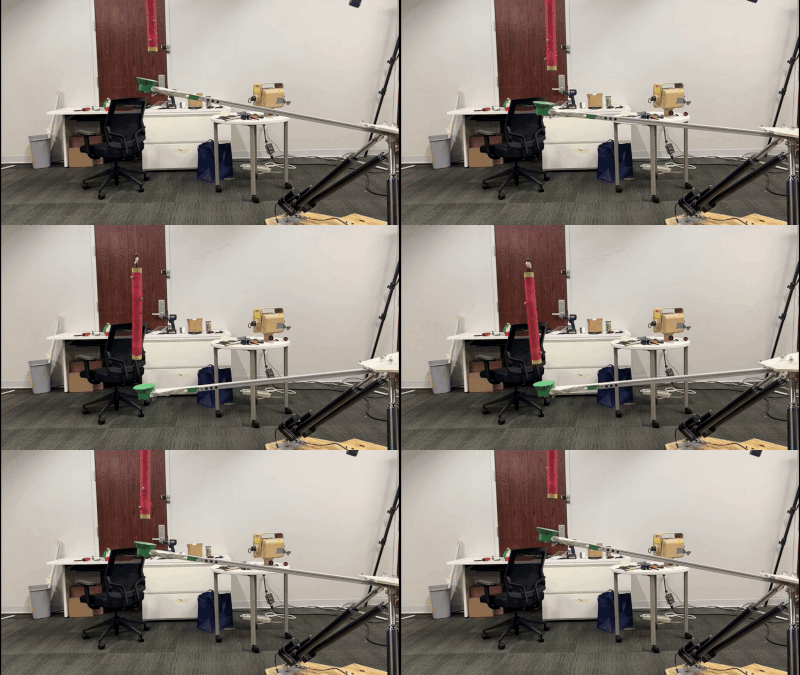
In DARPA LINC Phase 1, we scaled the core ideas from Phase 0 to a significantly more challenging setting in safe autonomy and human–robot interaction: developing a Learning Introspective Control (LINC) system for Crane-on-Ship Replenishment at Sea operations.
Under a range of adversarial conditions, including a moving platform simulating aggressive sea states, close-proximity obstacles, and degraded actuator performance, our approach maintains bounded payload oscillations while enabling a human operator to intuitively control the crane. This allows the payload to be maneuvered reliably and inserted into assigned goals despite disturbances.
To stress-test the system, the 6-DoF motion platform was commanded to induce highly aggressive sea states. When LINC is disabled, the injected energy exceeds the system’s natural dissipation, resulting in chaotic, uncontrollable payload motion.
The video below demonstrates that our proposed method preserves controllability and stability even in these extreme conditions, allowing a human-operated crane to complete a replenishment task safely and effectively.