Reach-Avoid Games
Efficient multi-agent reach-avoid dynamic games solver
This project (Anthony et al., 2022) implements and demonstrates computationally efficient, time-consistent solutions to multi-agent reach-avoid dynamic games, a class of safety-critical optimal control problems where agents aim to reach goal sets while avoiding failure conditions under adversarial or interactive dynamics. These games are widely used as formal models in mobile robot motion planning, autonomous driving, and safety-critical decision making.
Our implementation supports single and multi-player reach-avoid environments, including cooperative and adversarial interactions, with tools for training, evaluation, and visualization.
Core Idea
A reach-avoid game involves agents that must:
- Reach a specified target
- Avoid unsafe regions or adversarial opponents
Reach-avoid cost is formulated, such that past failures override future successes. The reach-avoid condition for a generic state trajectory $\mathbb{x} = (x_0, \dots, x_T)$ can be expressed as:
\[\exists t \in \{0,\dots,T\} : x_t \in \mathcal{T}_t \wedge \forall \tau \in \{0,\dots,t\} : x_\tau \not\in \mathcal{F}_\tau\]Solutions are time-consistent, meaning that planned trajectories remain optimal at all timesteps (later control inputs are still optimal despite suboptimal behavior earlier in the trajectory), or time-inconsistent (pinch-point solution).
Highlights & Demos
Single-Player Reach-Avoid
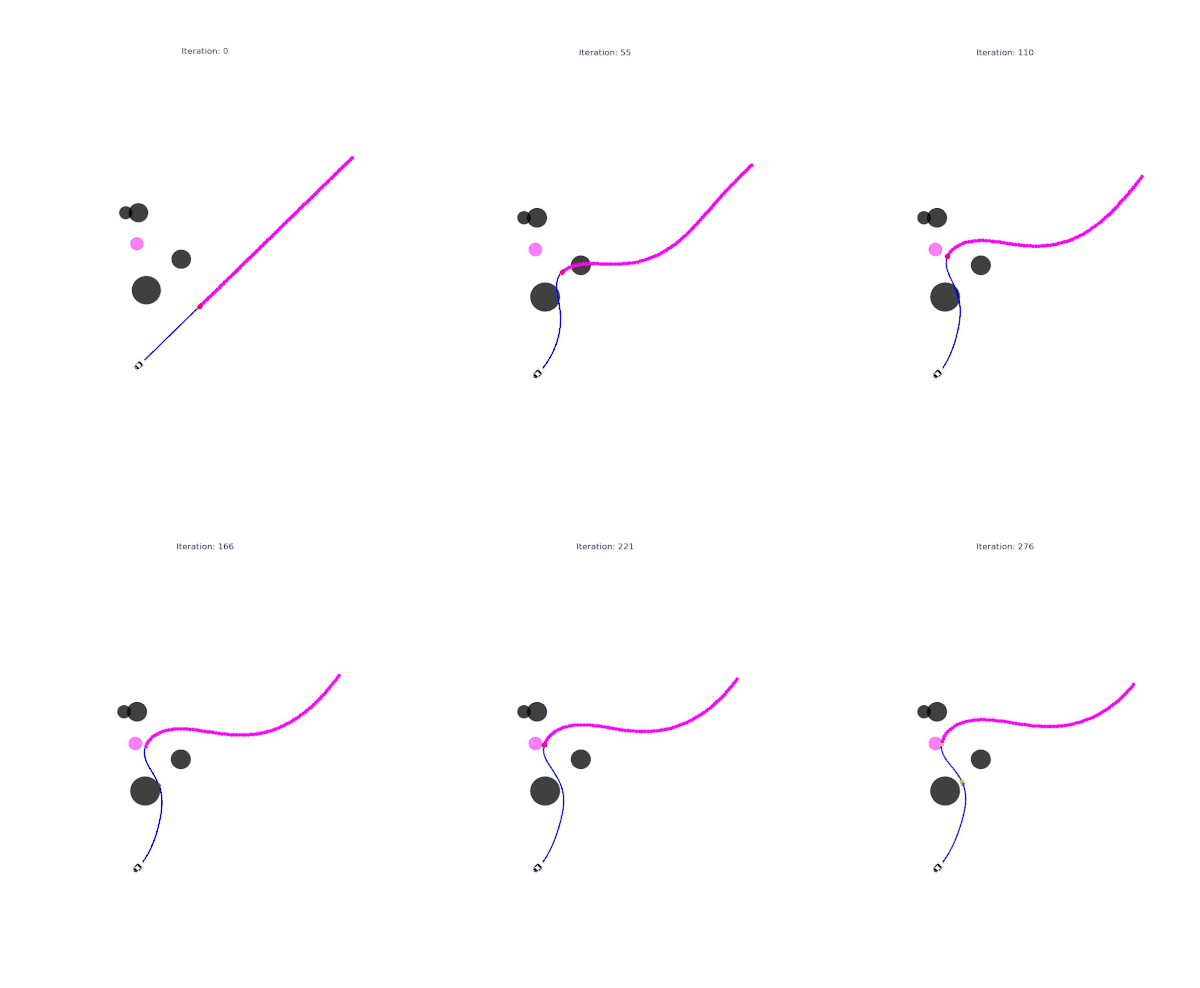
One agent navigates a free space with obstacles toward a goal while maintaining safety constraints. We show the result from both time-inconsistent (pinch-point) and time-consistent solution:


Multi-Player Scenarios
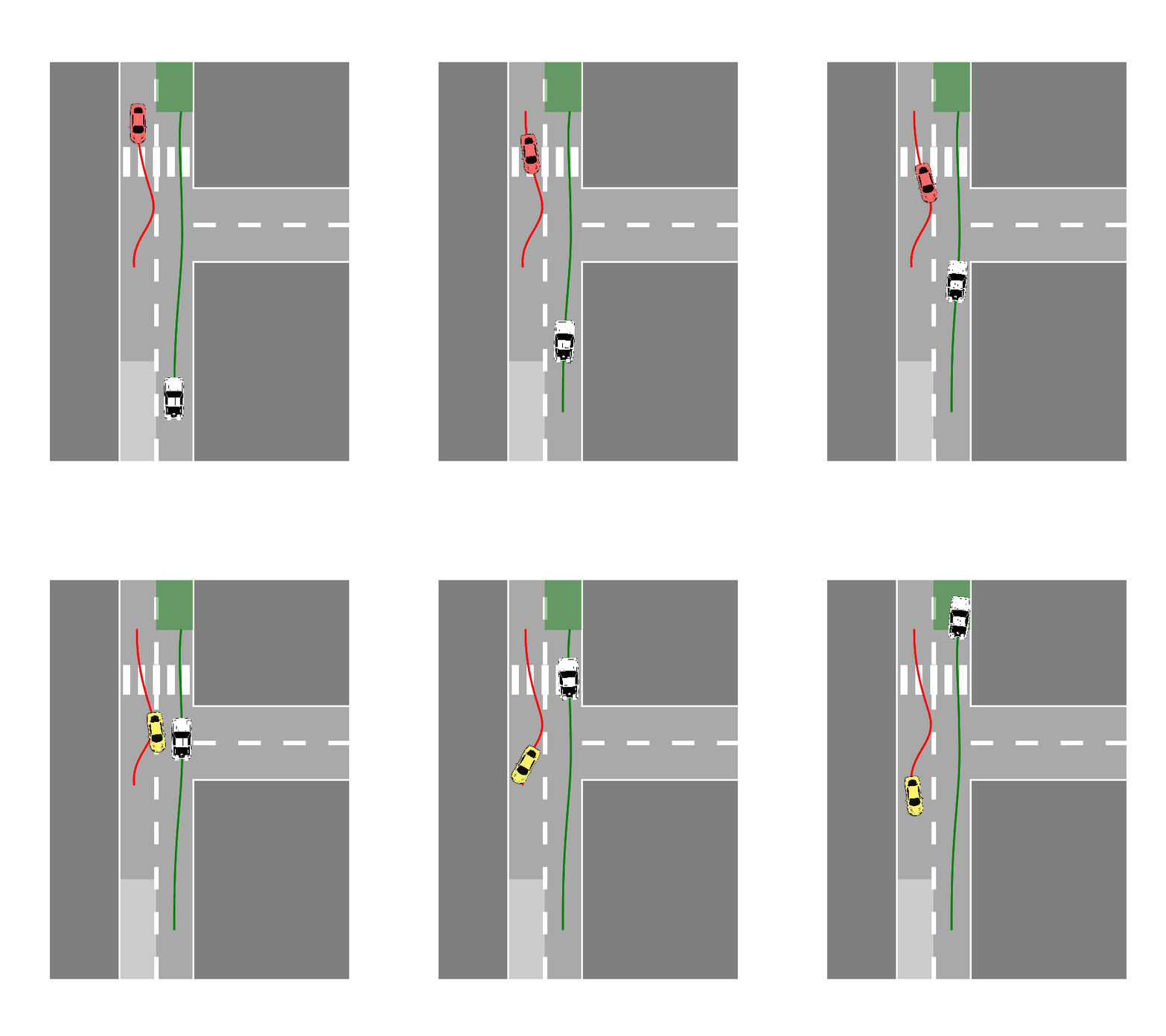
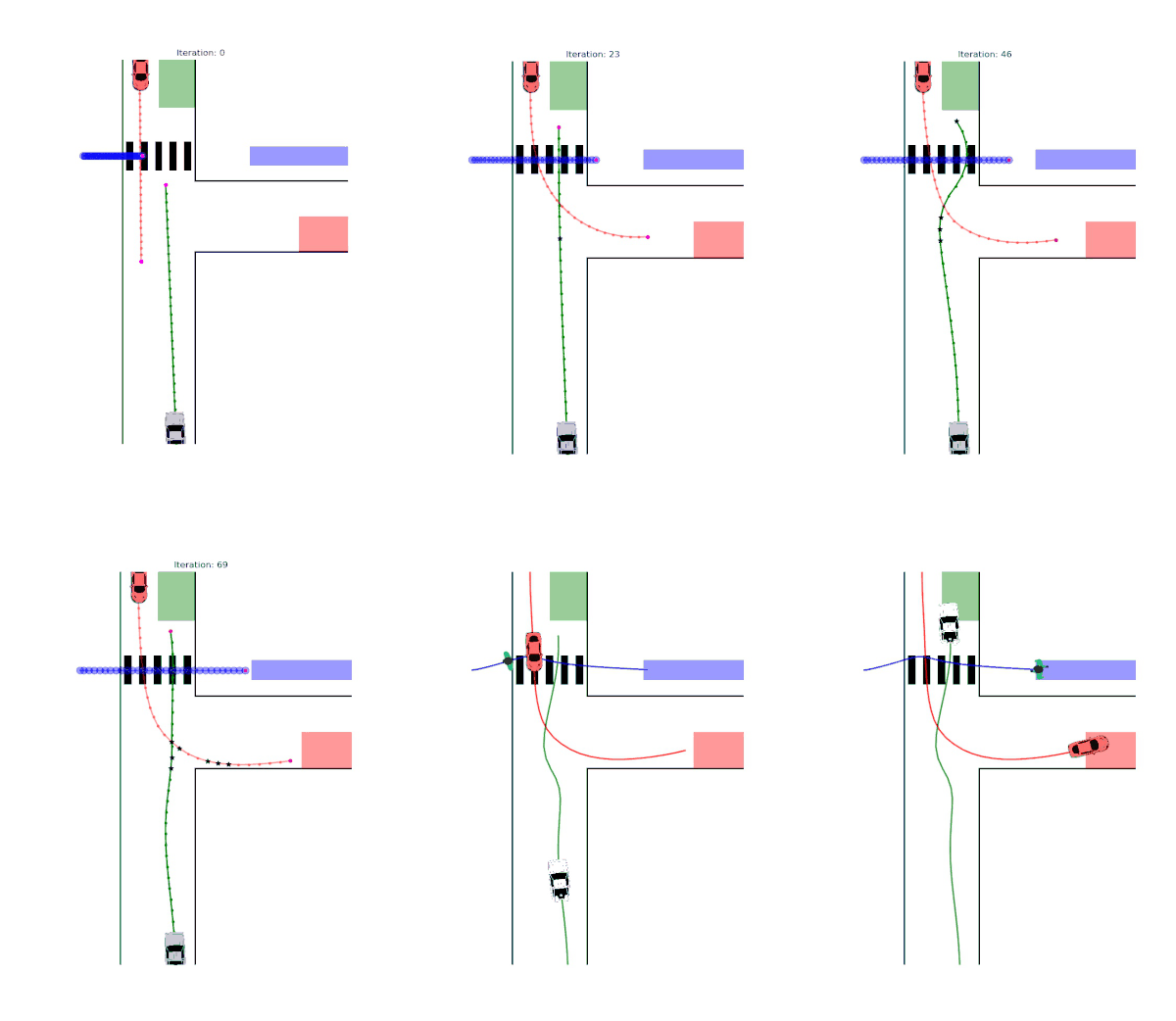
- Two-Player Interactions: Cooperative or adversarial reach-avoid dynamics
- Three-Player Games: Complex interaction patterns demonstrating scalable behavior synthesis
Publication
This work was accepted to ICRA 2022 as Back to the Future: Efficient, Time-Consistent Solutions in Reach-Avoid Games, introducing algorithms for efficiently computing solutions that remain optimal under execution perturbations.